Showing posts with label cheese. Show all posts

Tuesday, February 26, 2013

It is Finished!

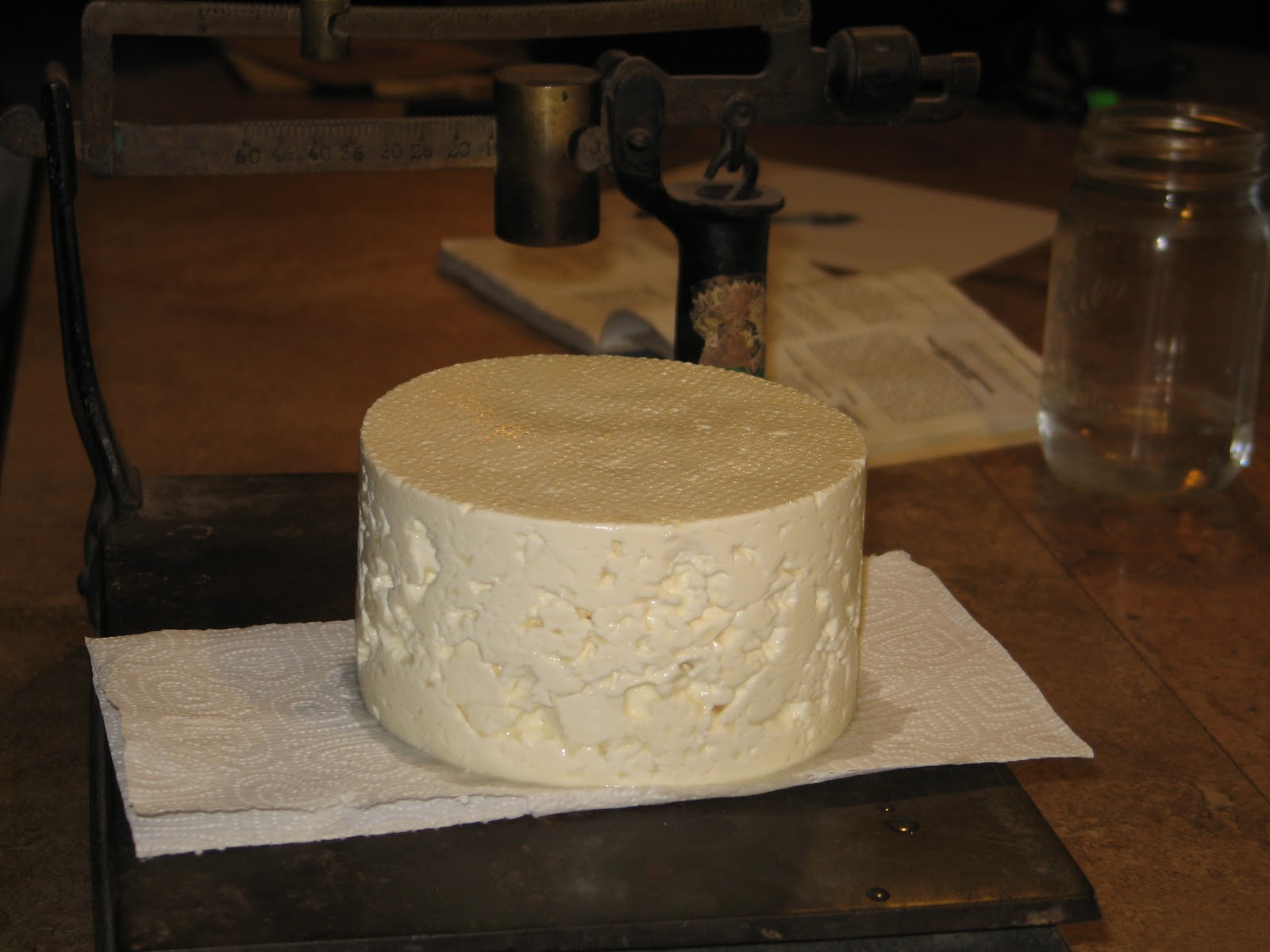
One thing fun about Camembert cheese is the short aging time.  The other is the transformation facilitated by the Penicilium Camemberti mold.  The cheese goes from being mild, firm and boring, to having a snow white exterior, and flavorful, lusciously silky inside.
Yes, the Camembert is already done!  
Actually, it could stand to go another week or two, but it tastes amazing and has lovely texture as it is.  I would like it to get a little oozier, but am also wondering if letting it go longer will cause it to develop an ammonia flavor.  The last batch I made had a hint of ammonia, and this one has none!  The rind on this cheese was even delicious...and I don't normally appreciate rinds.


Wednesday, February 6, 2013

Camembert Update!

The Camember are well on their way to being runny, flavorful cheeses!
Here are the four wheels, just starting to develop whiskers of mold...
And then a little more mold...
 
Once the mold became thick, I patted it all down, to limit its growth slightly.
Technically, I was supposed to wrap them in cellophane, but since I didn't have it, I had to do without.  Patting down the mold has pretty much the same effect as wrapping in cellophane...
I am very pleased with their progress so far!!

Saturday, January 19, 2013

Fancy Cheese...Camembert!

Soo....I started making cheese again a couple weeks ago.  
An interesting cheese I just made is Camembert.  For those that may not know, Camembert is a mould-ripened cheese.  The mould causes the inside of the cheese to become runny, and develop a flavor quite a few people enjoy.  It can be difficult to get right, since you only want one kind of mould to grow on the surface of the cheese.  This particular mould is called Penicillium Camemberti and is bright white and fuzzy.  You can buy it freeze-dried, in the form of yellowish powder...
Camembert cheeses are made in small rounds in order to let the mould do it's work all the way to the center of the cheese.
     
I started making this cheese by heating two gallons of whole, raw, cow's milk to 90F.
As soon as the milk reached 90F I inoculated the milk with mould powder.
I stirred it in for a minute or two; basically until I was sure the mould powder was thoroughly mixed.
After adding the mould powder, I added starter culture.  Starter culture is the bacteria cheesemakers put in the cheese to develop flavor and acid levels.
I made 'mother' culture by sterilizing milk, inoculating it with store-bought, freeze-dried bacteria, and then freezing the resulting coagulated, bacteria-laden milk.
Here are the culture cubes...
I added 4 of them...about 4 ounces of culture.
After adding the starter culture, I allowed the cheese to 'ripen' for 90 minutes.  
In that time of waiting, I prepared a place for the cheese to age.
I already had a Gouda and a Cheddar
 
and a sausage, down in the cheese room. 
I decided to age the Camembert in a tiny fridge in the room, in order to be better able to control the temperature and humidity.
I wiped it down with vinegar to hopefully remove any residual unwanted moulds.

After allowing the cheese to ripen the proper amount of time, I added 30 drops of rennet dissolved in 1/4 C water.
The milk rested for an hour (which was probably too long, considering that I seemed to have added a little bit too much rennet).
After that, I cut the curd into 1/2 inch cubes, stirred it for 15 minutes, let it rest for 15 minutes, then ladeled the curd into Camembert forms.
I used four cheese molds to drain the cheese....four small cheeses!
...and a funny contraption to catch the whey.
I allowed them to drain for five hours, turning them once every hour.
Then I took them out, spread Kosher salt all over the outside and let them sit 10 minutes.
Finally, they went into the basement, into the mini fridge, to grow mould and become runny...

Thursday, September 27, 2012

What a Long Hot Summer!

For the first time, I am actually looking forward to Autumn!
This summer was the hottest and driest most people can remember.  We had to lug water for the garden nearly every day...in order to actually produce produce.  The heat was great for peppers, tomatoes, eggplant, and some of the other veggies though...
Look at the size of those Lemon Drop pepper plants!!

Since the harvest has been coming in, I have made a few varieties of hot sauce, dried cayenne, dried sweet peppers, smoked varieties of hot peppers, a couple ristras, and sold and eaten lots of fresh peppers.
I even made a connection with a local hot sauce maker to piggyback onto his bottle order to make my hot sauces look professional!
5oz Woozy bottles with Cayenne sauce and The Redheaded Stepchild hot sauce mix!! (we haven't finished making labels...)

I sure do enjoy working with peppers!  Next year I plan on trying some rather unusual types of super-hot peppers...

Something else that has been making this summer busy is my dating/courting someone!  I've been trying to keep up with my responsibilities at home, and do as much as possible with 'My Man'.
Just recently we decided we wanted to get married, so are working on figuring out an appropriate date for that event.
Wow!  It is strange to think, at this time last year, I had no idea this was coming!

I didn't end up taking any bike trips this year, and haven't ridden as much as I would have hoped.  I even got my driver's license...
  I am not getting a car, though.  No way!  Bicycles are the way to go!

The milk supply I was using for cheesemaking stopped, since the farmer ended up with calves...but hopefully this winter I'll be able to start that up again.

Sorry it has been so long since I posted....I'll try to post more regularly, but I really can't promise anything....especially when my life is busy with unblogworthy stuff...


Thursday, February 23, 2012

Gorgonzola Goop...

One reason Gorgonzola isn't as strong flavored as Stilton is because the surface growth gets scraped off periodically.
I just scraped it for the first time...very interesting!!
The surface was covered with white mold, blue mold that seemed to be dying, and yellow-orange bacterial smear.

I scraped it off, and ended up with a lot of goop!

The cheese smells quite repulsive, but I tried a small piece that broke off the side, and it tasted amazing.
It was creamy, with nice blue mold flavor.

The final scraped cheese looks a little less wild than before....and hopefully the blue mold will be able to take over the rind.

It goes to the basement to age for a couple more months....


Tuesday, January 24, 2012

Will it work??

I pulled the Gorgonzola out of the mold today, and wasn't terribly impressed by what I saw.
Because there were no holes in the sides of the mold, the whey had no way to escape.  (pun intended)

I salted the cheese, and put it in a small fridge in the basement, to potentially stay at 55*F for 30 days.

I hope it doesn't just fall apart!

Saturday, January 21, 2012

Gorgonzola? We'll see....

Well, I made my very first batch of Gorgonzola cheese!  We shall see, in time, how it turns out...

Here's a photo of the beautiful Jersey milk I used.

I added mesophyllic starter culture, let it ripen for 30 minutes, then added rennet.  Here I am checking to identify the flocculation point.  "Flocculation" is the point at which the solids begin to separate from the liquids in the milk.  The evening milk took 11 minutes to flocculate, and the morning batch 10 minutes.  Therefore, I let the evening batch rest 45 minutes total, to get the best curd set for this cheese.  The morning milk set 40 minutes.

After the designated time for setting up, I cut the curd into 1/2 in cubes and let them rest 10 minutes.

The next step was to dump the curds into a cheesecloth to drain.  The evening bit drained for about 17 hours, and the morning curd drained for only one.

While waiting for the morning curd to finish draining, I mixed up an inoculate so the cheese grows blue mold.  I used 1 tsp of Gorgonzola cheese (the moldiest part I could find) and mixed that thoroughly with 1/4 cup of cool water.

Finally I was able to cut up the two batches of curd and mix salt and the blue cheese slurry into them.  

I put the larger bowl of curd (the morning curd) on the bottom and sides of the mold.  The smaller bowl of curd went into the center, surrounded on all sides by the newer curd.  

Now I have to flip the cheese every 15 minutes for 2 hours.  Then it goes into a cool room for 3 days.  I still have to flip it a few times each day, but not quite as often.  After that, it will go to start growing mold!